AI in Classrooms 2026: 7 Surprising Ways It’s Secretly Transforming Education
AI in classrooms 2026 is reshaping how teachers plan, grade, and support students. Here's what's really happening behind the scenes.
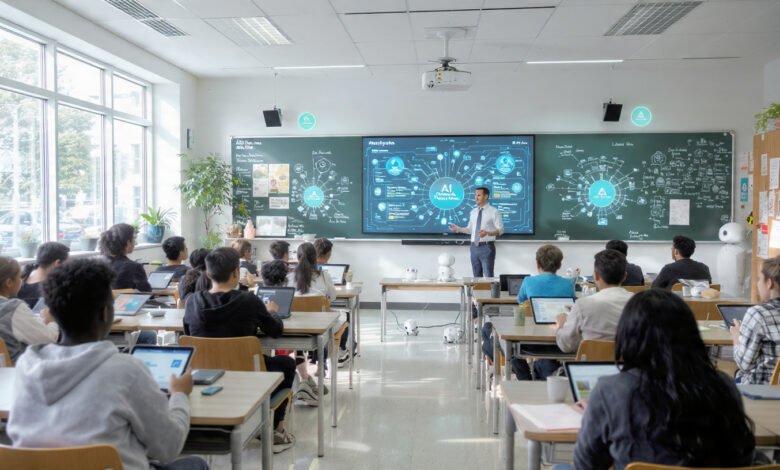
Walk into most schools today and nothing looks that different. Same desks, same whiteboards, same bell schedule. But ask a teacher what happens after the last bell rings, and you’ll get a very different picture. AI in classrooms has moved from a buzzy pilot program to something teachers quietly rely on every single day, and most parents have no idea how deep it goes.
This isn’t the flashy, robot-teacher version of the future that headlines love to predict. It’s smaller and more practical than that. It’s a teacher using AI to build a differentiated worksheet in ten minutes instead of an hour. It’s a student getting instant feedback on a rough draft at 9 p.m. instead of waiting three days. It’s a district trying to figure out how to write a policy before the technology outruns it.
By 2026, AI in education has stopped being a novelty and started being infrastructure. Recent research backs this up: a Center for Democracy and Technology survey found that 85% of teachers and 86% of students used AI during the last school year, the highest adoption levels recorded since the group started tracking the trend. That’s not a trend anymore. That’s just how school works now.
This article walks through what’s actually changing in classrooms this year, what’s driving it, and what teachers, parents, and administrators should know before jumping in.
1. Lesson Planning Has Quietly Become an AI-Assisted Task
Ask any teacher what eats the most hours outside the school day, and lesson planning is usually near the top. That’s where AI in classrooms has made its biggest, least visible dent.
Teachers now routinely use AI tools to:
- Draft lesson outlines aligned to state standards in minutes rather than hours
- Generate multiple versions of the same lesson for different reading levels
- Build quizzes, exit tickets, and rubrics on the spot
- Translate materials for English language learners in real time
- Brainstorm discussion questions or project ideas when they hit a creative wall
Platforms built specifically for teachers, rather than general-purpose chatbots, have made this shift practical. Tools offering dozens of purpose-built templates for lesson planning, differentiation, and assessment have become common in staff rooms, often adopted teacher-to-teacher rather than through a formal district rollout.


According to Gallup’s Teaching for Tomorrow research with the Walton Family Foundation, teachers who use AI tools at least weekly save an average of 5.9 hours per week, which adds up to roughly six weeks over the course of a school year. That’s not a marginal improvement. That’s a teacher getting back the equivalent of an extra planning month, every year, without cutting corners on instruction.
2. Grading and Feedback Loops Are Getting Shorter
One of the more underrated shifts in AI in classrooms 2026 is how much faster feedback moves. A student used to hand in an essay on Monday and get comments back on Thursday, if they were lucky. Now that gap is shrinking to hours, sometimes minutes.
AI grading assistants can:
- Score objective assessments instantly, freeing teachers for essay-level work
- Draft first-pass comments on written work that the teacher reviews and edits
- Flag common grammar or reasoning errors across a whole class at once
- Surface patterns, like a shared misconception on a math concept, mid-unit rather than at the end of a grading cycle
Teachers aren’t handing grading over wholesale. The pattern that’s emerged is closer to a draft-and-review workflow: the AI produces a first pass, the teacher checks it against their own judgment, and the final grade or comment is still a human call. Survey data supports this caution paying off. Teachers report meaningful quality gains when they use AI this way, with the majority saying AI improves the feedback they’re able to give students rather than replacing their judgment.
H3: Why Teachers Are Still Careful Here
Grading is also where teachers are most hesitant. It’s the task most tied to a teacher’s professional judgment, and getting it wrong has real consequences for a student’s grade and confidence. That’s why adoption for grading specifically still lags behind lesson planning and worksheet creation, even as overall AI use climbs.
3. Personalized Learning Is No Longer Just a Buzzword
For years, “personalized learning” was one of those phrases that sounded great in a district strategic plan and meant almost nothing in a classroom of 30 kids. AI-powered personalized learning is starting to close that gap for real.
Adaptive platforms can now:
- Adjust the difficulty of practice problems in real time based on how a student is performing
- Offer reading passages at a student’s actual level instead of a grade-wide average
- Give struggling students extra scaffolding without singling them out in front of peers
- Push advanced students toward more challenging material automatically
This matters most for students who’ve historically fallen through the cracks: English language learners, students with learning differences, and kids working below or above grade level in a mixed classroom. One documented case involved a first-grade teacher using AI translation tools to help a struggling English learner move from barely participating to strong proficiency in math within a matter of weeks, work that previously required an entire afternoon of manual material adaptation and now takes under ten minutes.
4. Administrative Work Is Shrinking, Freeing Up Teacher Time
Teaching has always come with a mountain of paperwork attached, and that hasn’t changed. What’s changed is how much of it AI now handles quietly in the background.
H3: The Tasks Getting Automated
- Attendance tracking and basic recordkeeping
- Drafting routine emails to parents
- Summarizing student progress for report cards
- Organizing and tagging instructional materials
- First drafts of sections in individualized education programs (IEPs)
Teachers consistently rank administrative work and worksheet or assessment creation as the two areas where AI saves the most time. That time doesn’t just disappear. Teachers say they’re reinvesting it into more detailed student feedback, more individualized instruction, and, just as importantly, getting home at a reasonable hour.
5. Schools Are Racing to Write the Rules Before the Technology Outpaces Them
Here’s the part that doesn’t get talked about enough: while teachers have been adopting AI tools organically, state and district policy has been scrambling to catch up. This is one of the quieter but more consequential stories of AI in classrooms 2026.
State legislatures have introduced well over a hundred bills this year addressing AI in schools, covering everything from student data privacy to disclosure requirements when AI is used in instruction. 2026 legislative tracking shows dozens of states addressing concerns around academic integrity, data privacy, algorithmic bias, misinformation, overreliance on automation, and the potential deskilling of educators, as lawmakers try to set guardrails around a technology that arrived in classrooms faster than most policy processes can move.
H3: What This Means for Districts
- More schools are adopting formal AI use policies rather than leaving it to individual teachers
- Data privacy requirements are tightening around what student information AI tools can access
- Some states now require parental notification when AI is used directly with students
- Professional development budgets are shifting to include AI training
Districts with formal AI policies in place tend to see teachers report larger time savings than those without, likely because clear guardrails reduce the guesswork and hesitation that comes with using a new tool without institutional backing.
6. Trust Is the Real Bottleneck, Not Capability
If you assumed the biggest obstacle to AI in education was the technology itself, the data says otherwise. The bigger issue is trust, and it cuts in a few different directions at once.
Half of parents and students surveyed in a Center for Democracy and Technology report on AI use in schools question whether teachers who use AI are really “doing their job.” At the same time, teachers report AI helps them personalize instruction and save time, but many also say it’s made it harder to verify whether student work is genuinely original. That’s a real tension: the same tool that helps a teacher differentiate a lesson is also the tool a student might use to shortcut the assignment entirely.
Common trust concerns include:
- Parents worried AI is replacing genuine teacher attention rather than supporting it
- Teachers uncertain how to detect AI-generated student work fairly
- Students unsure where the line is between “using AI to learn” and “using AI to avoid learning”
- Administrators cautious about liability and data privacy when adopting new tools
The schools navigating this well tend to be transparent about it. They tell parents which tools are in use, they teach students explicitly how AI can and can’t be used for a given assignment, and they redesign assessments so that copying an AI response doesn’t actually demonstrate mastery.
7. Redesigned Assessment Is Becoming the Real Story of 2026
This is arguably the least visible but most important shift happening right now. Faced with the reality that students can generate a plausible essay in seconds, many educators are rethinking how they check for understanding in the first place, rather than trying to police AI use after the fact.
What this looks like in practice:
- More in-class writing and fewer take-home essays as the sole measure of skill
- Process-based grading that values drafts, revisions, and reasoning, not just a polished final product
- Oral defenses or short verbal check-ins where students explain their own work
- Tools that capture a student’s spoken reasoning rather than only their written answer
- Project-based assessments that are harder to outsource wholesale to a chatbot
This is a genuinely constructive response to a real problem. Rather than treating AI purely as a threat to academic integrity, forward-thinking teachers are treating it as a reason to build assessments that were arguably overdue for a redesign anyway.
What Parents Should Actually Know
Parents don’t need to become AI experts to stay informed, but a few basics go a long way:
- Ask your child’s school if they have a written AI use policy and what it covers
- Understand that AI-assisted grading almost always still involves a teacher’s review, not a fully automated decision
- Talk to your kids directly about appropriate versus inappropriate AI use for schoolwork, since the line isn’t always obvious to them either
- Know that data privacy protections vary significantly by state, so it’s worth checking what your local rules actually require
What Teachers Should Keep in Mind
For educators still deciding how deep to go with these tools, a few practical guardrails matter more than which specific product you choose:
- Start with one tool and one task rather than trying to overhaul your whole workflow at once
- Treat AI output as a first draft you review, not a final answer you publish
- Keep the tasks that require real judgment, like grading nuance or emotional context, firmly in human hands
- Document how you’re using AI so you can explain it clearly to parents or administrators if asked
The Bigger Picture
None of this adds up to AI replacing teachers, despite what some of the more dramatic headlines suggest. What it adds up to is something less dramatic and, honestly, more useful: teachers getting hours of their week back, students getting faster feedback, and struggling learners getting support that used to be logistically impossible in a room of thirty kids. The friction points are real too, around trust, academic integrity, and privacy, and those aren’t going away just because the tools keep improving.
AI in classrooms 2026 isn’t a single dramatic transformation. It’s dozens of small, practical shifts happening at once, mostly out of public view, in lesson plans, grading queues, and parent emails that used to take twenty minutes and now take three. That’s the quiet part of the story, and it’s the part actually worth paying attention to.
Conclusion
AI in classrooms in 2026 looks less like a science-fiction overhaul and more like a steady, practical shift happening in the background of everyday teaching. From faster lesson planning and shorter feedback loops to more personalized instruction for students who need it most, the technology is quietly reshaping how schools run day to day. At the same time, real challenges around trust, academic integrity, and data privacy are pushing states and districts to write policy almost as fast as teachers are adopting the tools themselves.
The schools getting this right aren’t the ones chasing every new AI product. They’re the ones being deliberate: keeping teachers in charge of judgment calls, being transparent with parents and students, and treating AI as a tool that supports good teaching rather than a replacement for it.