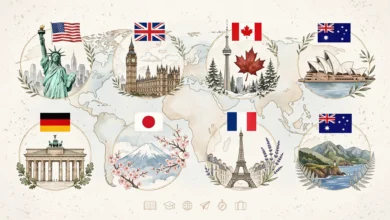
Student Visa Guide 2026: Requirements, Documents, and Application Tips
Your complete Student Visa Guide — covering visa types, required documents, financial proof, interview tips, and country-specific rules to help you study abroad successfully.
Student visa applications are more competitive and more scrutinized in 2026 than they have been in years. Immigration authorities in the US, UK, Canada, and Australia have tightened their documentation standards, introduced new fees, and raised the bar for financial proof. Thousands of well-qualified students still get rejected every year — not because their academics are weak, but because their paperwork is incomplete, inconsistent, or poorly timed.
This guide is written for students who want to get it right the first time. Whether you are applying for an F-1 student visa for the United States, a Student Route visa for the United Kingdom, or a study permit for Canada, the fundamentals are the same: you need the right documents, enough money in the right accounts, and a clear reason for your choice of school and program.
What has changed in 2026 is the level of detail expected at every step. Consular officers are cross-checking DS-160 forms against I-20 data. UK Visas and Immigration is scrutinizing 28-day bank statement windows more carefully. Canada eliminated the Student Direct Stream entirely, meaning every applicant now goes through the same regular-stream process.
The good news is that if you start early, organize your documents properly, and understand what each country actually needs, getting a student visa is absolutely achievable. This guide will walk you through exactly how.
Student Visa Guide 2026: Understanding the Basics
Before diving into documents and deadlines, it helps to understand what a student visa is and why each country has its own version of it.
A student visa is a nonimmigrant visa — meaning it is temporary — that allows a foreign national to enter a country for the specific purpose of studying at an accredited institution. It is not the same as a tourist visa, and you cannot use a visitor visa or a visa waiver program for full-time academic study. Using the wrong visa category is one of the fastest ways to be denied entry at the border.
Why 2026 Is a Critical Year
Several policy shifts have made the 2026 student visa application landscape more demanding than usual:


- The US introduced a new $250 Visa Integrity Fee for certain applicants, in addition to the existing $185 MRV fee and $350 SEVIS I-901 fee.
- Canada discontinued the Student Direct Stream (SDS) in late 2024, so all applicants now use the regular stream, which takes 6–16 weeks depending on your country.
- The UK has maintained its 28-consecutive-day funds requirement, with banks and consular officers checking statement dates more carefully.
- Australia raised its genuine student threshold, placing more emphasis on why applicants chose their specific institution and how the program fits their career path.
Understanding these changes before you apply will save you significant time and stress.
Major Student Visa Types You Need to Know
Different countries use different names for their international student visa categories. Here is a breakdown of the most common ones.
US Student Visa Types
The United States offers three main visa categories for students:
- F-1 Visa — The most common type. It is for academic studies at accredited colleges, universities, and language institutes. Most students apply for an F-1.
- J-1 Exchange Visitor Visa — For students enrolled in exchange programs at the high school or university level.
- M-1 Visa — For vocational or non-academic training programs.
To apply for any of these, you must first be accepted by a school certified by the Student and Exchange Visitor Program (SEVP).
UK Student Route Visa
The UK uses a points-based immigration system. Students apply for what is officially called the Student Route visa (previously Tier 4). To qualify, you must be 16 or older and hold an unconditional offer from a UK institution with a valid student sponsor licence. Your school will issue you a Confirmation of Acceptance for Studies (CAS) number, which anchors your entire application.
Canada Study Permit
Canada does not issue a student visa per se. Instead, international students apply for a study permit, which serves the same purpose. Your school must be a Designated Learning Institution (DLI). Most undergraduate and college-level applicants also need a Provincial Attestation Letter (PAL) from the province where they will study. Master’s and doctoral students at public DLIs are exempt from the PAL requirement as of January 1, 2026.
Australia Student Visa (Subclass 500)
Australia’s Subclass 500 student visa covers all levels of study, from secondary school through postgraduate programs. The application is made online through the Department of Home Affairs portal. A key component is the Genuine Student requirement, which replaced the older Genuine Temporary Entrant (GTE) statement and places more emphasis on written justification for your choice of course and institution.
Complete Student Visa Requirements Checklist 2026
The specific requirements vary by country, but every student visa application shares a common core. Here is what you will almost certainly need, regardless of your destination.
1. Valid Passport
Your passport must be valid for the duration of your stay, plus a buffer period. In the US, it must remain valid for at least six months beyond your intended program end date. If your passport is expiring within the next year, renew it before starting your visa application. Consular processing can take weeks, and an expired or soon-to-expire passport will stall or kill your application.
2. Official University Acceptance Letter
You cannot apply for a student visa without first being accepted by an eligible institution. This is the document that triggers everything else:
- In the US, acceptance at a SEVP-approved school triggers the issuance of your Form I-20.
- In the UK, your offer letter leads to a CAS (Confirmation of Acceptance for Studies) from your school.
- In Canada, your acceptance letter from a DLI is submitted directly as part of your study permit application, and your school will help initiate the PAL process where required.
Make sure your acceptance letter is unconditional. Conditional offers will not satisfy visa requirements.
3. Financial Proof
Financial documentation is the part of the application where most students run into trouble. Every country needs to see that you can actually pay for your education and living costs without working illegally.
Acceptable forms of financial evidence typically include:
- Personal or family bank statements — Usually required to show funds held for a minimum period (28 consecutive days in the UK, up to 28 days in the US).
- Scholarship or grant letters — Official documents from the awarding institution, stating the amount and duration.
- Sponsor letters — If a parent, relative, or employer is funding your studies, they must provide a signed sponsorship letter along with their own financial documents.
- Government sponsorship letters — If a government agency is paying for your education, an official letter from that body is required.
One important point: consular officers are trained to spot sudden large deposits that appear just before the application date. They want to see stable, long-term financial activity. Do not move borrowed money into your account hoping it will pass; it usually does not.
4. Proof of English Language Proficiency
Most English-speaking destination countries require official proof that you can function academically in English. Accepted tests include:
- IELTS Academic — Widely accepted for UK, Canada, and Australia.
- TOEFL iBT — Most commonly used for US universities.
- PTE Academic — Increasingly accepted by UK and Australian institutions.
- Duolingo English Test — Accepted by a growing number of US universities but not yet standard everywhere.
Minimum score requirements vary by institution and program. Always check with your specific school before booking a test.
5. Academic Transcripts and Certificates
Visa authorities need to confirm you are academically eligible for the program you have been accepted into. You will typically need:
- High school transcripts or diplomas (for undergraduate applicants)
- University transcripts (for postgraduate applicants)
- Degree certificates or provisional certificates
- For postgraduate research programs, you may also need recommendation letters and a research proposal
All documents not in English need certified translations.
6. Biometric Information
Most countries now require biometrics — fingerprints and a photograph — as part of the visa process. In the UK, this is done at a Visa Application Centre (VAC). In the US, biometrics are captured at the consulate interview. In Canada, you pay a separate biometrics fee and attend a biometrics appointment before your interview.
Book your biometrics appointment early. During peak seasons (May through September), VAC and consulate appointment slots fill up weeks in advance.
7. Medical Examination
Some countries require a medical exam from an approved physician, particularly for longer programs. The UK requires tuberculosis (TB) test results for applicants from certain countries. Australia requires a health examination for visa applicants from higher-risk countries. Results from non-approved physicians are not accepted, so book through your consulate’s official list of panel physicians.
US-Specific Student Visa Requirements
Form I-20 and SEVIS Fee
After being accepted by a SEVP-certified school, you will receive Form I-20 (Certificate of Eligibility for Nonimmigrant Student Status). This is the cornerstone document for your F-1 application. Once you have it, you must pay the SEVIS I-901 fee:
- F-1 students: $350
- M-1 students: $220
- New in 2026: An additional $250 Visa Integrity Fee may apply depending on your nationality and program.
Keep your SEVIS fee receipt. You will need it at your interview.
DS-160 Online Application
Every US nonimmigrant visa applicant must complete the DS-160 form through the Department of State’s Consular Electronic Application Center. You will need to enter your travel history, education history, employment history, and personal details. The information on your DS-160 must match your I-20 exactly. Discrepancies between the two documents are a common reason for interview complications.
F-1 Visa Interview Tips
The visa interview is mandatory and typically takes 5–10 minutes, but it carries significant weight. Consular officers are assessing three things: whether you are a genuine student, whether you have enough money to complete your studies, and whether you plan to return home after graduation.
Practical tips for your interview:
- Know your school. Be ready to explain why you chose that specific institution, what the program involves, and how it connects to your career goals. Vague answers raise red flags.
- Speak naturally. Memorized speeches are easy to spot. Practice your answers out loud with a friend or mock interview partner.
- Bring organized documents. Use labeled folders so you can produce requested materials quickly without fumbling.
- Demonstrate home ties. Family, a job offer, property, or community involvement in your home country all help show that you intend to return.
- You can enter the US no earlier than 30 days before your program start date. Know this date and have your I-20 handy.
UK Student Route Visa: What You Need in 2026
CAS Number and Conditions
Your Confirmation of Acceptance for Studies (CAS) is a unique reference number issued by your school. It contains the details of your course, your tuition fees, and any conditions attached to your offer. You must submit your CAS number as part of your online visa application through the UK government’s official portal at gov.uk/student-visa.
Financial Requirements for UK Student Visa
The financial requirements for a UK student visa are precise:
- You must show enough money to cover your full first year of tuition (if not already paid) plus 9 months of living expenses.
- For students studying in London: £1,334 per month, totaling £12,006 for 9 months.
- For students studying outside London: £1,023 per month, totaling £9,207 for 9 months.
- Funds must be held in your account for 28 consecutive days, ending no more than 31 days before your application date.
Bank statements must be original or certified copies. If they are in a language other than English, a certified translation is required.
Immigration Health Surcharge (IHS)
UK student visa holders must pay the Immigration Health Surcharge, which grants access to the National Health Service (NHS) during your stay. The current rate is £776 per year. For a typical three-year undergraduate degree, that is approximately £2,587 total — paid upfront at the time of application. This is non-refundable.
Canada Study Permit: 2026 Updates
PAL Requirement
As of 2026, most undergraduate and college-level applicants to Canadian institutions must obtain a Provincial Attestation Letter (PAL) in addition to their acceptance letter. Your DLI initiates the PAL process with the provincial government after you accept your offer and pay a deposit. Master’s and PhD students at public institutions are exempt.
The PAL requirement was introduced to manage intake volumes at a provincial level. Without it, your study permit application will be refused without further review.
Financial Requirements for Canada
Canada requires you to show:
- First year of tuition (exact amount shown on your acceptance letter)
- CAD $10,000 for living expenses (or CAD $833 per month if your program is less than a year)
- Plus additional amounts for accompanying family members
Processing Times
With the discontinuation of SDS, all applicants go through the regular stream. Processing times in 2026 vary:
- Low-risk countries with complete applications: 4–6 weeks
- India: approximately 8–14 weeks
- High-refusal-rate countries or complex cases: up to 16 weeks
Apply during off-peak periods where possible. Applications submitted between May and July (for September intakes) face longer wait times due to volume.
Common Reasons for Student Visa Rejection
Understanding why applications fail is just as important as knowing what to include. The most common reasons for student visa denial across all major destinations include:
- Insufficient or suspicious financial evidence — Low bank balances, sudden large deposits, or funds that don’t cover the full cost of study
- Weak ties to your home country — No job, family, or property to return to
- Inconsistent information — Differences between your visa application form and your university documents (I-20, CAS, etc.)
- Poor interview performance — Vague, inconsistent, or overly rehearsed answers
- Incomplete document checklist — A missing tuberculosis test, an unsigned form, or an expired police clearance
- Previous immigration violations — Overstaying a visa, unauthorized employment, or prior refusals not properly disclosed
If you have been refused before, disclose it. Consular officers can see your immigration history, and hiding a previous refusal is treated as misrepresentation — which can result in a permanent ban.
Application Timeline: When to Start
Timing is one of the most underestimated parts of the student visa process. Here is a realistic timeline based on a September intake:
| Milestone | Recommended Timing |
|---|---|
| Apply to universities | October–January of the previous year |
| Receive acceptance letter | February–April |
| Receive I-20, CAS, or DLI letter | Within 2–4 weeks of acceptance |
| Open or top up bank account for financial proof | At least 30–40 days before applying |
| Complete DS-160 / online visa application | 3–6 months before program start |
| Pay SEVIS / visa fees | Same time as application |
| Book biometrics and interview appointments | Immediately after submitting application |
| Attend interview / biometrics | 4–10 weeks after application |
| Receive visa decision | 2–8 weeks after interview |
For the US specifically, starting 6–12 months before your program start date is the general recommendation from immigration advisors. Canada’s regular stream processing makes a minimum 4–6 month lead time advisable.
Practical Student Visa Application Tips
These are the things that experienced international students and education advisors consistently point to as the difference between a smooth application and a painful delay.
Start Your Financial Paper Trail Early
Do not wait until you are ready to apply to think about your bank statements. Start depositing funds or ensuring balances are at the required levels at least 60 days before your application date. This gives you a buffer in case something goes wrong.
Keep Documents Consistent
Every document in your application should tell the same story. Your name, date of birth, program details, and institutional information must match across your passport, acceptance letter, DS-160 or visa application form, I-20 or CAS, and financial documents. Even small inconsistencies — a middle name on one document but not another — can cause delays.
Get Certified Translations
If any document in your application is not in English (or the official language of the country you are applying to), get it professionally translated by a certified translator. Courts and consular offices do not accept Google Translate outputs or uncertified translations.
Understand Your Visa Conditions Before You Travel
Once you have your visa, take the time to read the conditions attached to it. Key things to understand for an F-1 student visa holder:
- You must maintain full-time enrollment each semester
- On-campus work is limited to 20 hours per week during term
- Off-campus employment requires CPT (Curricular Practical Training) or OPT (Optional Practical Training) authorization
- You have a 60-day grace period after your program ends before you must leave or change status
Violating your visa conditions can affect future immigration applications anywhere in the world.
Authoritative Resources for Student Visa Applications
When in doubt, go directly to the government source. Here are two essential starting points:
- The US Department of State’s Student Visa page contains the official DS-160 portal, SEVIS fee payment links, and embassy locators.
- The IRCC Canada Study Permit Guide covers the full PAL process, DLI verification, and financial requirements.
These resources are updated regularly and should always be cross-checked against any third-party guide, including this one.
Conclusion
Navigating the Student Visa Guide 2026 requires more preparation than ever before, but the process is manageable when you break it down step by step. Start with your university acceptance, secure your financial documents well in advance, and make sure every piece of paperwork — from your passport to your bank statements — is complete, consistent, and current. Whether you are applying for a US F-1 visa, a UK Student Route visa, or a Canada study permit, the core principle is the same: be honest, be organized, and give yourself enough time. Rushing a visa application is the most common and most avoidable mistake international students make.