The Future of EdTech: Emerging Trends Every Student and Teacher Should Know
The future of EdTech is reshaping classrooms with AI, VR, and adaptive learning. Here's what students and teachers need to know right now.
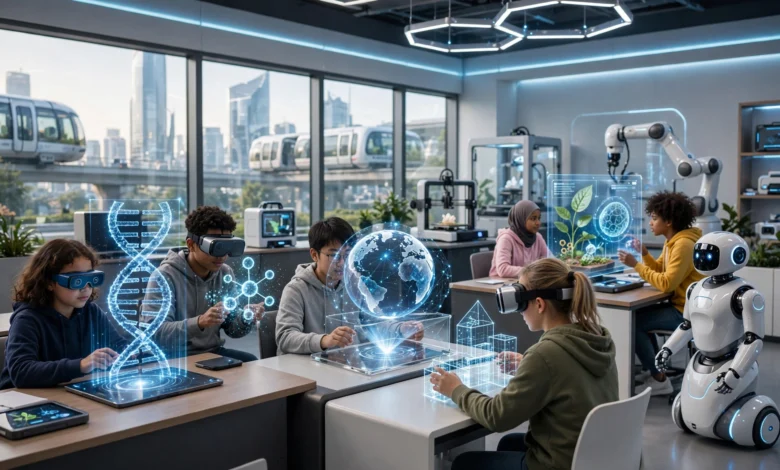
The future of EdTech is not some distant concept being debated in Silicon Valley boardrooms. It is happening right now, inside classrooms, on laptops, through headsets, and across platforms that barely existed a decade ago. Education is changing faster than at any point in modern history, and the technology driving that change is getting smarter, more accessible, and more personal by the year.
Consider the numbers. The global education technology market was valued at $187 billion in 2025 and is projected to reach $437.5 billion by 2033, growing at a compound annual growth rate of 10.8%. That is not just market growth — that is a signal that the world is betting heavily on tech-powered learning as the standard, not the exception.
But this is not just a story about money or market caps. It is about a student in a rural area finally accessing career pathways she never could before. It is about a teacher spending less time on administrative work and more time actually teaching. It is about personalized learning paths that adjust in real time based on how a student thinks and learns.
Whether you are a student trying to understand where education is headed, or a teacher wondering how to stay relevant and effective, this article walks you through the most important EdTech trends shaping the classroom of tomorrow. No jargon, no hype — just what is actually happening and why it matters.
The Future of EdTech: Why It Matters More Than Ever
Before jumping into specific trends, it is worth understanding why educational technology has moved from a “nice to have” to a central pillar of modern learning.
The COVID-19 pandemic forced schools worldwide to shift online almost overnight. What was supposed to be a temporary adjustment exposed deep cracks in traditional education — outdated infrastructure, inequitable access, rigid teaching models, and a curriculum that was slow to adapt. Schools that had invested in digital learning tools survived the disruption. Those that had not, struggled.
That forced experiment also revealed something important: technology, when used well, can make learning more effective, more engaging, and more equitable. It can meet students where they are, instead of forcing everyone to move at the same pace.


Now, with those lessons learned, EdTech innovation is accelerating. Institutions are not just adopting new tools because they are shiny — they are doing it because the data shows it works.
10 Emerging EdTech Trends Reshaping Education in 2025 and Beyond
1. AI-Powered Personalized Learning
If there is one trend that sits at the center of the future of EdTech, it is artificial intelligence in education. AI is fundamentally changing how students learn and how teachers teach — and the adoption rate is striking.
According to a 2025 report by the Center for Democracy and Technology, 85% of teachers and 86% of students used AI tools in the preceding school year. Among educators, 69% said those tools improved their teaching, and 55% reported having more direct time with students as a result.
What does AI actually do in the classroom? Quite a lot:
- Adaptive learning platforms analyze a student’s performance in real time and adjust the difficulty, pacing, and format of content accordingly. If a student consistently struggles with fractions, the platform does not move on — it tries a different explanation.
- Automated grading tools handle routine assessments, freeing teachers from hours of marking multiple-choice quizzes.
- AI tutors provide instant, on-demand support for students who need help outside school hours.
- Lesson planning assistants help teachers generate curriculum materials, differentiated assignments, and quiz banks in minutes.
The global AI education market reached $7.57 billion in 2025 and is projected to exceed $112 billion by 2034. That growth is not a bubble — it reflects genuine, measurable impact in classrooms around the world.
The catch? Many teachers are not getting the training they need to use these tools effectively. One HMH survey found that 36% of educators received no AI training at all. As AI in education becomes the norm rather than the exception, professional development has to keep up.
2. Adaptive Learning Systems That Meet Students Where They Are
Closely tied to AI, adaptive learning deserves its own section because it represents a fundamental shift in the philosophy of education. Traditional schooling operates on a one-size-fits-all model: the teacher delivers content, the class moves forward together, and students who fall behind have to catch up on their own. Adaptive systems break that model entirely.
Adaptive learning technology uses data — performance scores, response times, error patterns, engagement metrics — to build a unique learning path for each student. If one student understands a concept after one explanation, the system moves on. If another needs three different approaches, it provides them without judgment and without delay.
Key benefits of adaptive learning include:
- Bridging learning gaps faster through focused reinforcement
- Reducing the pressure on teachers to differentiate instruction manually
- Keeping advanced students challenged rather than bored
- Providing struggling students with support without the stigma of “being behind”
Platforms using machine learning algorithms to power these systems are becoming less of a novelty and more of a baseline expectation, particularly in higher education and K-12 math and reading programs.
3. Virtual and Augmented Reality in the Classroom
Not long ago, virtual reality (VR) in education was a curiosity — an expensive experiment for well-funded private schools. That is changing fast. As headset costs drop and content libraries grow, VR and AR are becoming practical tools for everyday instruction.
The use cases are compelling:
- VR field trips let students visit ancient Rome, the surface of Mars, or the inside of a human cell — without leaving the classroom.
- Augmented reality (AR) overlays can project 3D models of a beating heart, a working engine, or a historical artifact directly onto a student’s desk.
- VR simulations allow students to practice skills like welding, surgery, or emergency response in a safe, repeatable environment.
For subjects where hands-on experience is traditionally difficult or expensive to provide — chemistry labs, geography, foreign cultures — immersive learning through VR and AR levels the playing field. A student in a rural school can have the same experiential learning opportunity as one in a well-resourced urban school.
AR and VR are not replacing teachers. They are giving teachers better tools to create experiences that text and video simply cannot replicate.
4. Gamification and Game-Based Learning
Gamification in education is not about letting students play video games instead of doing schoolwork. It is about borrowing the mechanics that make games addictive — points, levels, badges, leaderboards, instant feedback, and a sense of progression — and applying them to learning.
The results are real. Gamified learning platforms consistently show higher completion rates, stronger engagement, and better retention compared to traditional content delivery. This is especially true for younger students and self-paced online courses, where motivation can drop without the social structure of a physical classroom.
According to market data, the K-12 segment led the EdTech market in 2025, in large part because of strong demand for game-based learning tools. Teachers widely support gamification initiatives, particularly for building math skills through practical, project-based challenges.
What effective gamification looks like in practice:
- Students earn points for completing assignments and lose points for certain behaviors, creating accountability
- Progress bars show how far a student has come in a unit, making achievement visible
- Collaborative challenges pit teams of students against each other in knowledge competitions
- Scenario-based learning lets students make decisions and live with the in-game consequences, building critical thinking
The key distinction between good and bad gamification is depth. Slapping a badge on a worksheet is not gamification. Designing a learning experience that creates genuine motivation and keeps students returning is.
5. Learning Analytics and Predictive Data
Learning analytics might be one of the most underappreciated trends in the future of EdTech. It refers to the collection and analysis of student data to understand and improve learning outcomes — and when done well, it gives teachers a level of insight that simply was not possible before.
AI-generated dashboards now provide educators with:
- Question-level performance data that shows exactly where students are struggling
- Accuracy heat maps that reveal patterns in errors across a class
- Skill mastery scores that track progress over time
- Predictive risk flags that identify students likely to fall behind before they actually do
That last point is particularly powerful. Predictive analytics can flag a student as at-risk based on changes in attendance, declining scores, or drops in engagement — weeks before a grade drops significantly enough to trigger a parent meeting. Early intervention, whether through tutoring, counseling, or adjusted instruction, becomes possible because the system surfaces the signal before the situation becomes a crisis.
For teachers, data-driven instruction means less guesswork and more targeted teaching. Instead of assuming what the class needs, they can see exactly what the data shows and adjust accordingly.
6. Hybrid and Blended Learning Models
The pandemic made hybrid learning a necessity. What emerged from that experience was a recognition that the binary choice between “in-person” and “online” was a false one. The best outcomes often came from a deliberate blend of both.
Blended learning models combine face-to-face instruction with online components, giving students flexibility while preserving the human elements of learning that technology cannot replace — discussion, mentorship, collaboration, and the kind of relationship that forms between a great teacher and a student.
Modern blended learning takes several forms:
- Flipped classrooms, where students watch video lectures at home and use class time for discussion and problem-solving
- Station rotation models, where students rotate between independent digital work and small-group instruction
- Flex models, common in higher education, where students set their own schedule with instructor support available as needed
The evidence supports blended approaches. When done well, they improve both student outcomes and teacher efficiency. Students get more control over their learning pace; teachers get more time for meaningful one-on-one interaction.
7. Lifelong Learning and Micro-Credentials
The traditional model — go to school, get a degree, get a job, retire — is breaking down. Careers now require continuous learning, and the education system is adapting to meet that demand.
Micro-credentials, short-term certifications that verify specific skills, are filling a gap that four-year degrees were never designed to fill. Employers increasingly want proof that a candidate can do a specific thing — write code, manage a project, analyze data — not just proof that they sat through four years of coursework.
Key developments in this space:
- Partnerships between educational institutions and employers to align curriculum with real-world skills gaps
- AI-powered platforms that identify an individual’s skill gaps and recommend targeted learning paths
- Blockchain-verified digital credentials that are portable, tamper-proof, and easier for employers to verify than a paper diploma
- Professional development platforms designed for working adults who cannot pause their careers to attend full-time school
The lifelong learning economy is one of the most exciting corners of EdTech because it expands the definition of who education is for. It is not just for students aged 5-22 anymore. It is for the 45-year-old professional who needs to upskill before automation changes their role. It is for the career-changer in their 30s who needs a new credential fast. EdTech is making all of that possible at scale.
For more on this shift, the World Economic Forum’s Future of Jobs Report provides compelling evidence for why continuous skills development is becoming mandatory across industries.
8. Smart Classrooms and Connected Learning Environments
The smart classroom is not just a buzzword. It refers to a physical or digital learning environment where technology is integrated seamlessly to improve instruction, engagement, and efficiency.
A fully realized smart classroom might include:
- Interactive whiteboards that allow teachers to annotate, project, and save lessons in real time
- AI-powered cameras that track engagement levels and flag when students appear disengaged
- Voice assistants that help teachers manage classroom logistics without interrupting instruction
- Integrated school management software that connects attendance, homework, grades, and parent communication in one system
One underappreciated element of smart classrooms is audio technology. Instructional audio systems — essentially amplified speaker systems that ensure every student hears the teacher clearly regardless of where they sit — have proven especially valuable for students with hearing difficulties or attention challenges. These systems have also taken on a safety function, integrating with building communication systems to enable discreet alerts and two-way calls during emergencies.
The connectivity challenge is real. Smart classrooms require reliable broadband, up-to-date devices, and ongoing technical support. Schools in under-resourced areas often lack all three. Addressing the digital divide is one of the most important equity challenges in the future of EdTech.
9. Cybersecurity and Student Data Privacy
As classrooms collect more data than ever before, the question of who owns that data — and how it is protected — becomes increasingly urgent. Cybersecurity in education has moved from a background IT concern to a frontline priority.
Educational institutions are now among the most targeted sectors for ransomware attacks, phishing attempts, and data breaches. Student records contain sensitive personal information, and schools often lack the dedicated security infrastructure that corporations take for granted.
Best practices emerging across the EdTech landscape include:
- Multifactor authentication for all platform access
- End-to-end encryption for student data
- Regular security audits to identify vulnerabilities before attackers do
- Digital literacy programs that teach both students and teachers how to recognize phishing attempts and handle data responsibly
The regulatory environment is also tightening. Laws governing student data privacy are evolving in many countries, and EdTech companies that cannot demonstrate strong data stewardship are finding it harder to win institutional contracts. For students and parents, understanding what data is being collected, and having the ability to opt out or request deletion, is becoming a reasonable expectation rather than a luxury.
10. STEM Education and Coding as Core Curriculum
Finally, the rise of STEM education as a central pillar of modern curriculum reflects a broader understanding that the jobs of the future will require technical literacy — not just for engineers and data scientists, but for almost everyone.
The STEM education market for school-age children is projected to reach $131.98 billion by 2030. The global coding bootcamp market is growing at 15% annually. Countries like China are introducing AI curriculum as early as age six. These are not isolated trends — they reflect a global consensus that computational thinking is as fundamental as reading and writing.
What this looks like in classrooms:
- Coding platforms that teach programming through interactive games and projects, starting in elementary school
- Robotics programs that bring physics, engineering, and problem-solving together in hands-on projects
- CTE (Career and Technical Education) courses that connect curriculum to real career pathways, including AI, cybersecurity, and data science
- School-employer partnerships that let students earn industry certifications while still in high school
For educators looking to stay current with what is working in STEM instruction, ISTE (International Society for Technology in Education) remains one of the most trusted resources for professional development, standards, and practical classroom guidance.
Challenges the EdTech Industry Still Needs to Solve
No honest assessment of the future of EdTech would be complete without acknowledging what is not working yet.
The digital divide remains a serious problem. Access to reliable internet, modern devices, and technically trained teachers is not evenly distributed. Rural schools, underfunded urban districts, and developing countries are often left behind when EdTech advances happen at the pace set by well-resourced institutions.
Teacher training is lagging. The tools are getting better faster than educators can absorb them. With 36% of teachers reporting zero AI training, even the best technology will underperform if the people using it do not feel confident. Professional development needs to keep pace with product development.
Screen time and mental health concerns are real. Three out of four U.S. states have adopted or are considering device restrictions in schools, driven by concerns about student mental health, distraction, and engagement. The same technology that enables powerful learning can also be a source of compulsive behavior and disconnection. Balanced digital citizenship education is essential.
Data privacy and algorithmic bias are issues that the EdTech industry has not fully resolved. When AI systems trained on historical data are used to predict which students are at risk, there is a genuine possibility that they reinforce existing inequalities rather than correcting them. Critical oversight matters.
What the Future of EdTech Means for Students
If you are a student reading this, the picture is mostly positive — but it requires active engagement on your part.
Personalized learning tools mean you have more control over how and when you learn. But that control comes with responsibility. Adaptive platforms work best when students engage honestly, not when they try to game the system for easy points.
AI tutors and tools can help you understand difficult concepts at 11pm when your teacher is unavailable. But critical thinking, creativity, and human connection are skills that technology cannot fully teach. Use the tools to sharpen your understanding — not to replace the thinking.
Micro-credentials and digital portfolios are increasingly valuable in the job market. Start building them early. A certification in data analysis, a completed coding project on GitHub, or a verified course in project management can differentiate you in ways a GPA alone cannot.
What the Future of EdTech Means for Teachers
For educators, the future of educational technology is an opportunity — not a threat.
AI does not replace teachers. It replaces the tedious parts of teaching: grading routine quizzes, tracking attendance, generating boilerplate lesson plans. What it cannot replace is the human relationship at the heart of great teaching. The ability to notice when a student is struggling emotionally, not just academically. The skill of leading a discussion that changes how a room full of people thinks about something. The authority and warmth that come from genuine expertise and genuine care.
The teachers who will thrive in the EdTech era are those who:
- Embrace ongoing professional development, including AI literacy training
- Use data from learning analytics to inform instruction rather than ignoring it
- Build lessons that use technology to enable experiences that would be impossible otherwise
- Continue to prioritize the human dimensions of teaching that no platform can replicate
Conclusion
The future of EdTech is already underway, and it is reshaping every dimension of how knowledge is taught, accessed, and verified. From AI-powered personalized learning and adaptive learning systems to VR classrooms, gamification, learning analytics, micro-credentials, and STEM education, the trends covered in this article represent a fundamental shift in what education can be. The market data, the classroom adoption rates, and the student outcomes all point in the same direction: technology, used thoughtfully and equitably, makes learning more effective and more accessible. But the tools are only as good as the people using them. Students who engage actively, teachers who invest in staying current, and institutions that prioritize both innovation and equity are the ones who will shape — and benefit from — what comes next. The future of education is not something that will happen to you. It is something you get to be part of.