Career Paths Most Likely to Survive AI Automation: 10 Smart Choices for 2026
Career paths that survive AI automation share one trait: human judgment. Here's where AI-resistant careers are heading in 2026.
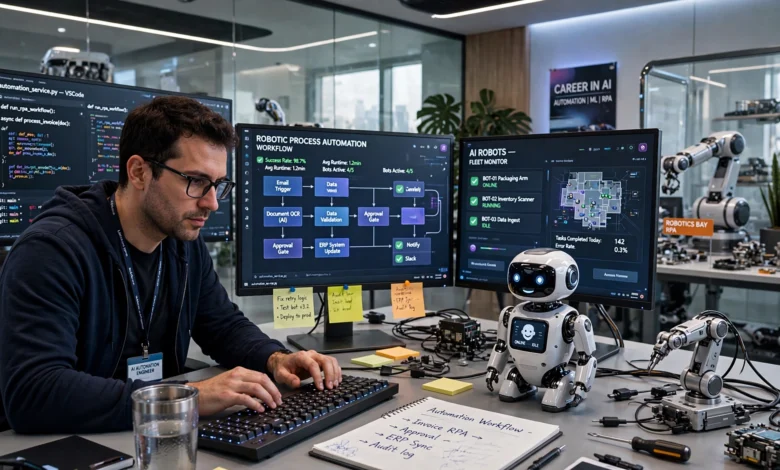
Career paths that survive AI automation aren’t the ones people expect. For years, the assumption was that physical, hands-on work would go first and knowledge work would last forever. That assumption is falling apart in real time. Generative AI writes reports, drafts code, and summarizes legal contracts faster than most junior employees, while a plumber’s job hasn’t gotten any easier to automate at all.
So if you’re trying to figure out where to put your career energy over the next decade, the old advice about “safe” jobs needs an update. The real dividing line isn’t collar color, it’s whether a job depends on routine, predictable tasks or on judgment, trust, and split-second human decision-making. A new AI-Resistant Careers Index built from U.S. Department of Labor data found that roles requiring adaptability, stress tolerance, and self-control under pressure hold up best, with nurse anesthetists, emergency physicians, and airline pilots sitting near the top.
This article breaks down the career paths most likely to survive AI automation, why they’re holding up, and what specific skills make them durable. It’s not a list of jobs that will never change. It’s a list of jobs where the human being stays the one making the final call.
What Actually Makes a Career AI-Resistant
Before getting into specific jobs, it helps to understand the pattern. Researchers studying automation-resistant careers keep landing on the same five ingredients, and most durable jobs have at least three of them.
- High-stakes judgment. Decisions with real consequences, where a wrong call causes serious harm, still need a human who can be held accountable.
- Physical unpredictability. Machines are excellent in controlled environments and much worse in messy, ever-changing physical spaces (a job site, an ER, a burning building).
- Emotional and relational trust. People want another person listening when they’re scared, grieving, sick, or making a big decision.
- Manual dexterity in non-standard settings. Wiring an old house, fixing a leaking pipe under a sink, or repairing a custom machine part requires improvisation that current robotics can’t match.
- Creative and strategic direction. AI can generate options quickly, but someone still has to decide which idea is actually right for the brand, the client, or the moment.
Jobs that are mostly the opposite of this list, repetitive data entry, basic bookkeeping, first-tier customer support, routine document review, are the ones already showing measurable softening in hiring. That’s not speculation. Industry data from 2025 and 2026 shows a real slowdown in entry-level coding, basic copywriting, and paralegal document review, even as demand grows in healthcare, skilled trades, and specialized technical roles.
1. Healthcare Roles That Require Hands-On Judgment
Healthcare consistently ranks as one of the strongest categories among AI-resistant careers, and it’s not close. AI can read scans, flag anomalies, and draft patient notes, but it can’t hold a scalpel, comfort a frightened patient, or take responsibility for a surgical outcome.
Roles to watch:


- Nurse anesthetists and nurse practitioners, both projected for strong growth
- Surgeons and emergency physicians
- Physical and occupational therapists
- Home health aides and direct caregivers
What ties these together is direct physical contact combined with legal and ethical accountability. AI can support a nurse’s workflow, but it can’t be the one who’s licensed, insured, and legally responsible when something goes wrong. That single fact, accountability, is doing more to protect these career paths from AI automation than any technical limitation.
2. Skilled Trades and Physical Repair Work
Electricians, plumbers, HVAC technicians, and general contractors work in physical conditions that change every single day. No two houses are wired the same way, no two boilers fail in the same spot, and no two job sites look alike. That variability is exactly what current robotics struggles with.
Demand for these trades is also getting an unusual boost from AI itself. Data centers, EV charging infrastructure, and grid upgrades all need electricians, and none of that work can be outsourced to a chatbot. If you want a genuinely future-proof career that doesn’t require a four-year degree, the trades are arguably the strongest bet on this entire list.
Why these hold up:
- Physical environments are too unpredictable for current robotics
- Licensing and safety codes require a human on record
- Local demand can’t be offshored or automated remotely
- Rising infrastructure needs (EVs, data centers, renewable energy) are increasing demand
3. Mental Health and Therapy Professions
Therapists, counselors, and psychologists sit near the very top of every automation-resistance ranking, and the reasoning is straightforward. People in distress want to be heard by another person, not a system trained to predict the next likely sentence. Clinical judgment about risk, medication interaction, and crisis intervention also carries legal weight that AI can’t hold.
This doesn’t mean AI has no role here. Mental health apps and chatbots are already used for journaling, mood tracking, and low-stakes support between sessions. But the licensed clinician making treatment decisions remains firmly human, and that’s unlikely to change given both the ethical stakes and current regulation.
4. Skilled Leadership and High-Accountability Roles
CEOs, chief information security officers, and judges show up repeatedly in automation-resistance data, and it’s a useful reminder that seniority itself is a form of protection. These roles combine complex judgment calls with personal accountability that can’t be transferred to software, no board or court will accept “the algorithm decided” as an answer.
Common traits of AI-resistant leadership work:
- Final decision-making authority with legal or financial consequences
- Emotional regulation under public or high-pressure scrutiny
- Responsibility for outcomes that a machine cannot be held liable for
- Negotiation and relationship management across competing interests
This is one of the clearer signals that jobs safe from AI aren’t only found at the entry level or in manual labor. They also cluster at the very top of organizations, where accountability, not task complexity, is the deciding factor.
5. Aviation and Safety-Critical Operations
Pilots are a favorite example in almost every study on this topic, and for good reason. Commercial aircraft already fly with extensive automation, autopilot has existed for decades, yet airlines still require two licensed pilots in the cockpit. The reason is simple: when something goes wrong at 35,000 feet, a human needs to make a fast, high-stakes decision with lives on the line, and passengers (and regulators) are not willing to remove that layer of human oversight.
The same logic extends to air traffic controllers, ship captains, and other roles where split-second human judgment in an emergency is considered non-negotiable, regardless of how advanced the supporting technology gets.
6. Skilled Creative Direction (Not Creative Production)
This is the category that surprises people most. Everyone assumed writers, designers, and marketers would be first to go, and entry-level production work in those fields has genuinely gotten harder to find. But creative direction, the part where someone decides what the brand should say, how a campaign should feel, and which idea actually connects with an audience, is holding up better than expected.
According to Upwork’s own 2025 hiring data, categories once considered most vulnerable to AI disruption, including writing and creative design, are actually growing rather than shrinking. The explanation is that AI is excellent at generating drafts and variations but still needs a human with taste, cultural awareness, and strategic judgment to choose the right one.
Roles in this category:
- Creative directors and brand strategists
- Senior copywriters who guide voice and positioning, rather than produce volume
- Art directors overseeing visual identity across a brand
- Documentary and narrative filmmakers making editorial choices
7. Skilled Trades in Restoration and Fine Craft Work
A smaller but genuinely durable niche sits in restoration work, furniture conservation, custom metalwork, instrument repair, and similar fine craft trades. These jobs demand a level of precision and material knowledge that’s difficult to encode, because every object being restored is slightly different, damaged in its own way, and made from materials that behave unpredictably.
This is a smaller job market than nursing or the trades broadly, but it’s worth mentioning because it shows the same underlying pattern: physical variability plus specialized human judgment equals real protection from automation.
8. Emergency and First-Responder Roles
Firefighters, paramedics, and emergency rescue teams operate in conditions that are, by definition, chaotic and unpredictable. Recent estimates put firefighting’s automation risk extremely low, largely because the job combines physical improvisation, real-time risk assessment, and split-second coordination with a team, none of which current AI or robotics can reliably replicate in a live emergency.
AI is already useful here in a supporting role: dispatch optimization, risk mapping, and predictive resource allocation are all improving. But the physical act of running toward danger and making decisions under extreme time pressure remains entirely human.
9. Skilled Education and Human Development Roles
Teachers, especially those working with young children or students with special needs, remain difficult to automate despite years of “AI will replace teachers” predictions. Managing a classroom of children, reading social and emotional cues, and adapting instruction moment-to-moment requires a kind of contextual judgment that current models don’t have.
Special education teachers in particular show up consistently in resilience rankings, since the job blends behavioral management, legal compliance (IEPs and accommodations), and one-on-one relationship building that simply can’t be templated.
10. Technical Roles That Combine AI Fluency With Human Oversight
Not every safe career path is about avoiding AI. Some of the most durable roles are the ones built around directing it. Cybersecurity leadership, AI governance, quality assurance for AI-generated output, and technical roles that require verifying, auditing, or correcting AI systems are all growing, not shrinking.
This matters because it reframes the whole conversation. The goal isn’t necessarily to find a job AI can’t touch. It’s to find a role where your judgment adds value on top of what AI produces, whether that’s catching an AI’s factual error, deciding which AI-generated option is actually usable, or taking legal responsibility for a decision AI helped inform.
In-demand hybrid roles include:
- AI governance and compliance specialists
- Cybersecurity analysts and CISOs
- Prompt engineering combined with subject-matter expertise
- QA and editorial oversight of AI-generated content
How to Future-Proof Your Own Career
Whatever field you’re in right now, a few practical moves consistently show up in the research on automation-resistant careers:
- Move toward judgment, not just execution. If your job is mostly following a defined process, look for ways to add decision-making, client relationships, or oversight responsibility to your role.
- Build in-person or high-trust skills. Roles that depend on face-to-face trust are harder to automate than remote, transactional work.
- Get comfortable directing AI tools rather than competing with them. Learning to use AI well is quickly becoming a basic job requirement, not a specialty.
- Watch licensing and accountability. Fields with strict certification requirements (healthcare, law, skilled trades) tend to be more resistant simply because liability can’t be automated away.
- Don’t panic over headlines. According to <cite index=”5-1″>Challenger, Gray & Christmas data, only about 4.5% of 2025 layoffs were directly attributed to AI</cite>, and much of the coverage runs hotter than the underlying numbers support.
It’s also worth putting the bigger picture in context. The <cite index=”7-1″>World Economic Forum’s Future of Jobs Report 2025 projects that global trends could create 170 million new roles by 2030 while displacing 92 million, a net gain of 78 million jobs</cite>. The story isn’t mass unemployment. It’s a large-scale skill shift, and the people who adapt early will have the most options.
Common Questions About AI-Resistant Career Paths
Will any job be completely untouched by AI?
Not really, and that’s fine. Even surgeons now use AI-assisted imaging, and pilots have flown with autopilot for decades. “AI-resistant” doesn’t mean AI-free. It means the final judgment, accountability, and physical execution stay with a human.
Are trade jobs really safer than office jobs?
In many cases, yes. Office roles built around repetitive, rules-based tasks (data entry, basic bookkeeping, routine document review) are automating faster than skilled trades, which require physical adaptability that current robotics can’t match.
Should I avoid tech careers because of AI?
No, but you should be selective. Entry-level coding and boilerplate development work have gotten more competitive. Cybersecurity, AI oversight, and senior engineering roles that require architectural judgment remain in strong demand.
What’s the single best skill to build right now?
Judgment under ambiguity. Whether you’re in healthcare, trades, creative work, or tech, the professionals who thrive are the ones who can look at an AI-generated option and know, based on experience and context, whether it’s actually right.
Final Thoughts
The career paths most likely to survive AI automation share a common thread: they depend on human judgment, physical adaptability, or personal accountability that software can’t take on, whether that’s a nurse anesthetist monitoring a patient, an electrician wiring an unpredictable job site, a therapist sitting with someone in crisis, or a creative director deciding which idea actually works. AI is changing how work gets done across nearly every industry, but it’s mostly automating tasks, not entire professions, and the roles holding up best are the ones where a human still has to make the final call and live with the outcome. Rather than trying to guess which job title will exist in ten years, the smarter move is building the skills that make you the one AI can’t replace inside whatever field you choose: sound judgment, hands-on adaptability, and the kind of trust only a person can earn.