Freelancing vs Full-Time Employment: What Fits Your Life Better?
Freelancing vs full-time employment: compare income, flexibility, benefits, and security to see which career path truly fits you.
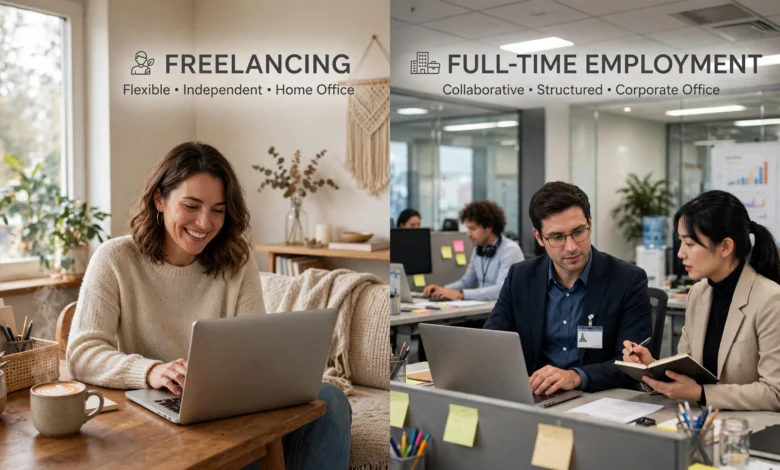
If you’ve been staring at your laptop at 11 p.m. wondering whether you should quit your job and go independent, or whether you should stop freelancing and finally get “a real job,” you’re not alone. The debate over freelancing vs full-time employment has become one of the most searched career questions of the decade, and for good reason. The way we work has changed dramatically over the past few years, and the old idea that a stable 9-to-5 is automatically the “safer” choice doesn’t hold up the way it used to.
Both paths have real advantages and real trade-offs. Freelancing gives you control over your schedule, your clients, and your income ceiling, but it also comes with unpredictable cash flow and zero built-in safety net. Full-time employment offers structure, benefits, and a steady paycheck, but it can limit your earning potential and your freedom to work the way you want.
There isn’t a universal right answer here. The right choice depends on your financial situation, your risk tolerance, your industry, and honestly, your personality. In this article, we’ll break down the real differences between freelancing and full-time employment, look at the pros and cons of each, and help you figure out which one actually fits your life right now, not just in theory.
What Is Freelancing?
Freelancing means working independently rather than being employed by a single company. As a freelancer, you’re technically self-employed. You take on projects or contracts from multiple clients, set your own rates, and manage your own schedule. You might be a graphic designer, a copywriter, a web developer, a consultant, or a virtual assistant. The common thread is that you’re running your own small business, even if it’s just you.
Freelancing has grown enormously thanks to remote work platforms, digital payment tools, and a cultural shift toward valuing flexibility over tenure. According to the U.S. Bureau of Labor Statistics, independent contractor and gig-based work arrangements have become a significant and growing part of the American labor market. This isn’t a fringe trend anymore. It’s a mainstream career path that millions of people rely on as their primary income source.
What Is Full-Time Employment?
Full-time employment is the traditional model most of us grew up expecting: you work for one employer, typically 35–40 hours a week, in exchange for a fixed salary or hourly wage plus benefits like health insurance, paid time off, and retirement contributions. Your employer handles tax withholding, sets your job responsibilities, and usually offers a defined career ladder within the company.
This model still dominates the workforce, and for good reason. It offers predictability. You know what you’re earning every month, you have coworkers and management structure to support you, and in many cases you get access to benefits that would be expensive or impossible to secure on your own.


Freelancing vs Full-Time Employment: Key Differences
To really understand freelancing vs full-time employment, it helps to compare them side by side across the factors that matter most in daily life.
Income and Earning Potential
With freelancing, your income is directly tied to the number of clients you land and the rates you charge. There’s no salary cap. Skilled freelancers who build a strong reputation and a steady client base can often out-earn their full-time counterparts, sometimes significantly. But income can also be inconsistent, especially in slow months or when a major client drops off.
Full-time employment, on the other hand, offers a fixed, predictable paycheck. Raises typically come through annual reviews or promotions, and your earning ceiling is often tied to your job title and company pay bands rather than how much work you’re willing to take on.
- Freelancers: variable income, higher upside, no ceiling
- Full-time employees: stable income, slower growth, capped by role
Work Schedule and Flexibility
This is where freelancing tends to win for a lot of people. You choose your own hours, decide which projects to accept, and can often work from anywhere with an internet connection. Want to work at 6 a.m. or midnight? That’s your call.
Full-time employment generally requires you to work set hours, sometimes from a specific location, and to align your schedule with your team or manager. Remote and hybrid roles have loosened this somewhat, but there’s still an expectation of availability during business hours.
Job Security and Stability
Full-time roles come with a stronger sense of job security, at least on paper. You have an employment contract, potential severance protections, and in many countries, legal protections against sudden termination.
Freelancers face a different kind of risk. A client can end a contract at any time, and there’s no unemployment insurance waiting if the work dries up. That said, freelancers often diversify across multiple clients, which means losing one client doesn’t wipe out your entire income the way losing a single job would.
Benefits and Perks
This is one of the biggest practical differences in the freelancing vs full-time employment decision. Full-time employees typically receive:
- Health insurance
- Paid vacation and sick leave
- Retirement plan contributions (like a 401(k) match)
- Life and disability insurance
- Paid parental leave
Freelancers are responsible for sourcing and paying for all of this themselves, which adds cost and complexity, especially healthcare in countries where it isn’t publicly funded.
Taxes and Financial Planning
Full-time employment simplifies taxes considerably. Your employer withholds income tax, Social Security, and Medicare contributions automatically. You get a single tax form at year-end and rarely need to think about it beyond that.
Freelancers are considered self-employed, which means they’re responsible for estimated quarterly tax payments, self-employment tax, and tracking their own deductible business expenses. Many freelancers work with an accountant or use dedicated software to stay compliant, which is an added cost and mental overhead that full-time employees simply don’t deal with.
Career Growth and Skill Development
In a full-time job, career growth often follows a structured path: promotions, internal training programs, mentorship from senior colleagues, and clear next steps. There’s usually a defined ladder you can climb.
Freelancers grow differently. Instead of climbing a ladder, they build a portfolio and a reputation. Every project is a chance to learn a new skill, work with a new industry, or expand into a new niche. Growth is self-directed, which can be incredibly rewarding for motivated people but isolating for those who thrive on mentorship and structure.
Work-Life Balance
This one really depends on the person. Freelancing can offer excellent work-life balance because you control your calendar. But it can also blur the lines between “work” and “life” since your office is often your living room, and there’s no clear clock-out time when you’re chasing deadlines across multiple clients.
Full-time employment usually has clearer boundaries, since work happens within set hours, but commuting, mandatory meetings, and limited vacation days can eat into personal time in ways freelancing doesn’t.
Pros and Cons of Freelancing
Pros:
- Full control over your schedule and workload
- No income ceiling, your earnings scale with effort and skill
- Ability to work with multiple clients and industries
- Freedom to work from anywhere
- Direct ownership of your business and brand
Cons:
- Inconsistent income, especially early on
- No employer-provided benefits
- You handle your own taxes and admin work
- No paid time off; if you don’t work, you don’t earn
- Requires strong self-discipline and business skills
Pros and Cons of Full-Time Employment
Pros:
- Predictable, stable paycheck
- Access to health insurance and retirement benefits
- Paid vacation, sick leave, and holidays
- Clear career path with mentorship and training
- Legal protections around termination and workplace rights
Cons:
- Limited control over your schedule
- Earnings capped by salary bands and promotion cycles
- Less flexibility to work from anywhere or set your own hours
- Career progress often tied to company politics and tenure
- Harder to diversify income beyond a single employer
Which One Fits Your Life Better?
The honest answer to the freelancing vs full-time employment question is: it depends on your priorities right now, not five years from now. Here’s a practical way to think it through.
Choose Freelancing If…
- You value flexibility and autonomy more than stability
- You already have savings or a financial cushion to handle income gaps
- You’re disciplined enough to manage your own schedule and deadlines
- You have marketable skills that are in demand outside a traditional office
- You want to build something of your own rather than climb someone else’s ladder
Choose Full-Time Employment If…
- You need predictable income to manage debt, a mortgage, or family expenses
- You value employer-sponsored health insurance and retirement benefits
- You prefer structure, mentorship, and a defined career path
- You’re early in your career and want to build foundational skills
- You’d rather focus on your craft than on running a business
How to Transition Between the Two
You don’t have to pick one path forever. Many professionals move between freelancing and full-time employment multiple times over a career, and there’s a smart way to do it.
- Test the waters first. Before quitting a full-time job, try freelancing on the side to see if you can consistently land clients and manage the workload.
- Build a financial cushion. Aim for three to six months of living expenses saved before making freelancing your main income source.
- Understand the tax shift. If you’re moving into freelancing, talk to an accountant early about quarterly taxes and deductible expenses. Resources like the IRS’s self-employed tax center are a good starting point for understanding your obligations.
- Negotiate benefits if returning to full-time work. If you’re moving from freelancing back into a full-time role, don’t just focus on salary. Ask about health coverage, remote flexibility, and retirement matching.
- Keep a portfolio either way. Whether you’re freelancing or employed, documenting your work and results makes future transitions much easier.
Frequently Asked Questions
Is freelancing more profitable than full-time employment? It can be, especially for people with in-demand skills and a strong client base, but income is less predictable, and freelancers have to cover their own benefits and taxes out of pocket.
Is it harder to get a mortgage as a freelancer? Sometimes, yes. Lenders often want two years of consistent self-employment income documentation, while full-time employees can usually qualify with recent pay stubs.
Can I do both freelancing and full-time employment at the same time? Many people do, as a way to test freelancing before committing fully, or simply to supplement their income. Just check your employment contract for any conflict-of-interest clauses first.
Which option is better for beginners just starting their career? Full-time employment is often better early on, since it provides mentorship, training, and a stable foundation before you have the experience and network needed to freelance successfully.
Conclusion
At the end of the day, the freelancing vs full-time employment decision isn’t about which path is objectively better. It’s about which one matches your financial needs, your personality, and the season of life you’re in. Freelancing rewards independence, flexibility, and self-direction, while full-time employment offers stability, benefits, and a clearer structure for growth.
Some people thrive with the freedom of running their own client base, while others do better with the security of a steady paycheck and a team around them. Whichever direction you lean, the smartest move is to go in with your eyes open about the trade-offs, plan your finances accordingly, and remember that this choice isn’t permanent. Careers evolve, and so can your working arrangement.