Soft Skills vs Hard Skills: What Actually Gets You Promoted
Soft skills vs hard skills: which one really moves you up the ladder? Here's what actually gets you promoted, backed by real workplace patterns.
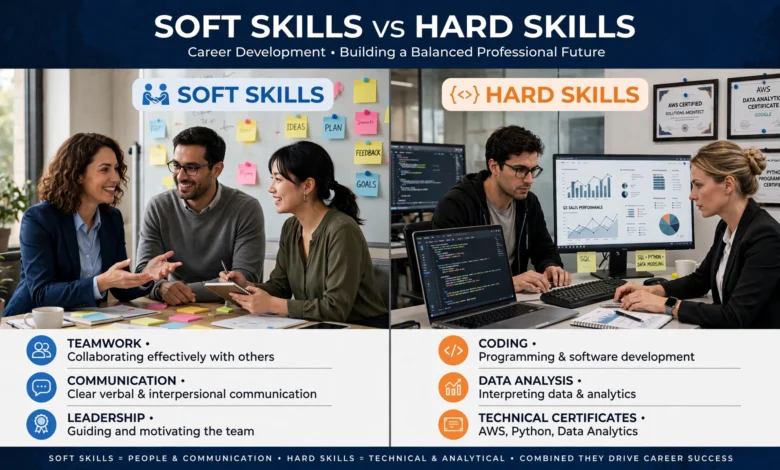
Soft skills vs hard skills is one of those debates that sounds simple until you’re the one sitting across from your manager during a performance review, wondering why the technically weaker person on your team got the promotion instead of you. You did the work. You hit your numbers. So what happened?
Here’s the honest answer: promotions rarely come down to one category of skill winning over the other. They come down to how well you’ve combined both, and how visible that combination is to the people making the decision. Hard skills get you hired and keep you competent at the job. Soft skills get you noticed, trusted, and eventually handed more responsibility. Ignore either one and you cap your own growth.
This article breaks down what separates the two skill types, where each one actually matters in the promotion process, and how to build a career strategy that doesn’t leave either side neglected. Whether you’re an engineer who codes brilliantly but struggles in meetings, or a natural communicator who’s never quite mastered the technical side of your role, understanding this balance is the difference between staying in place and moving up.
What Are Hard Skills?
Hard skills are the measurable, teachable abilities tied directly to a job function. They’re the things you’d list on a resume because they can be tested, certified, or demonstrated with a portfolio.
Examples include:
- Programming languages like Python or SQL
- Financial modeling and data analysis
- Project management certifications (PMP, Scrum Master)
- Foreign language fluency
- Operating specialized equipment or software
- Legal research, accounting, or engineering calculations
The appeal of hard skills is that they’re objective. A hiring manager can look at a coding test score or a certification and know, roughly, what they’re getting. That’s why hard skills dominate job descriptions and why so many people assume they’re also what drives promotions. It’s a reasonable assumption. It’s also incomplete.
What Are Soft Skills?
Soft skills are the interpersonal and behavioral traits that shape how you work with other people. They’re harder to measure but just as real in their impact.


These include:
- Communication and active listening
- Emotional intelligence
- Adaptability under pressure
- Conflict resolution
- Time management and prioritization
- Leadership and the ability to influence without authority
Soft skills don’t show up on a certificate. They show up in how a meeting goes when you’re in the room, how a project recovers when it hits a snag, and how people feel about working with you again. Managers notice this even when they can’t always articulate it in a review.
Soft Skills vs Hard Skills: The Real Difference
The clearest way to separate the two is this: hard skills determine whether you can do the job. Soft skills determine whether people want you doing more of it.
Think about it from a manager’s perspective. When they’re deciding who to promote, they’re not just asking “who is the most technically skilled person on my team.” They’re asking “who can I trust to represent this team in front of leadership,” “who will other people actually want to work under,” and “who can handle the ambiguity that comes with more responsibility.” Technical skill answers the first question. It rarely answers the other two.
This is why the soft skills vs hard skills conversation isn’t really about picking a winner. It’s about recognizing that hard skills open the door and soft skills are what get you invited further inside.
What the Research Says About Promotions
This isn’t just workplace folklore. Multiple studies on career advancement point to the same pattern: technical competence gets you considered, but interpersonal skill gets you selected. The World Economic Forum has repeatedly flagged skills like analytical thinking, resilience, and leadership as core to future employability, alongside technical literacy — not instead of it. You can review their ongoing research on evolving workplace skill demand through the World Economic Forum’s Future of Jobs research.
Similarly, Harvard Business Review has published extensively on how emotional intelligence and communication ability correlate with leadership effectiveness at senior levels, often more strongly than raw technical output. Their ongoing coverage on management and leadership development is a solid starting point if you want to dig deeper into how organizations actually evaluate readiness for promotion, available through Harvard Business Review’s leadership section.
The pattern across this research is consistent: as you move up the ladder, the weight shifts. Entry-level roles reward hard skills heavily. Mid-level and senior roles increasingly reward the ability to lead, communicate, and adapt.
Why Soft Skills Often Tip the Scales
Communication
You can be the most brilliant person in the room, but if you can’t explain your thinking clearly, that brilliance stays locked inside your head. Communication is consistently ranked by hiring managers and executives as one of the top factors in promotion decisions. It’s not about being the loudest voice. It’s about being the clearest one.
People who communicate well:
- Translate complex ideas into simple language for different audiences
- Write concise, actionable emails and reports
- Ask good questions instead of guessing
- Give feedback that people can actually use
Emotional Intelligence
Emotional intelligence, often shortened to EQ, is the ability to recognize and manage your own emotions while reading the emotional state of others. This matters enormously once you’re managing people or working across departments with competing priorities.
Someone with strong EQ can walk into a tense meeting, read the room, and adjust their approach without anyone having to tell them to. That’s a skill that becomes more valuable, not less, the higher you climb.
Leadership and Influence
Leadership isn’t a title. It’s a behavior pattern that shows up long before someone officially manages a team. People who get promoted into leadership roles usually demonstrated leadership behavior first, informally, by:
- Taking initiative on problems nobody assigned to them
- Mentoring newer team members without being asked
- Building consensus instead of forcing decisions
- Owning mistakes and fixing them quickly
This kind of informal influence is one of the strongest predictors that someone is ready for more responsibility.
Where Hard Skills Still Matter Most
None of this means hard skills are optional or secondary. In technical fields especially, hard skills remain the entry ticket. You won’t get promoted into a senior engineering role if your code quality is inconsistent, no matter how well you communicate. You won’t move into a finance leadership position without solid modeling and analysis ability.
Hard skills matter most in these situations:
- Early career stages, when you’re still proving basic competence
- Highly technical or regulated industries, like medicine, law, or engineering, where errors carry real consequences
- Specialist roles, where deep expertise is the actual value you provide
- Performance-based promotions, where output is directly measurable (sales numbers, code shipped, cases closed)
The mistake isn’t valuing hard skills. It’s assuming they’re the only thing that matters once you’ve cleared the baseline.
How to Balance Both for Career Growth
The people who advance fastest aren’t necessarily the most talented in either category. They’re the ones who deliberately build both sides instead of leaning entirely on their natural strengths.
Building Hard Skills Strategically
Don’t just accumulate skills randomly. Be intentional:
- Identify the specific technical gaps between your current role and the one above it
- Pursue certifications or training that are recognized in your industry, not just generic courses
- Take on stretch projects that force you to use skills you haven’t fully developed yet
- Ask your manager directly what technical competencies they associate with the next level
Developing Soft Skills On the Job
Soft skills are trickier because they’re built through practice, not study. A few practical ways to grow them:
- Volunteer to lead a small project, even a low-stakes one, to practice coordinating people
- Ask for direct feedback on how you come across in meetings, not just on your output
- Practice active listening by summarizing what someone said before responding
- Observe people who are already respected leaders in your organization and notice specific behaviors, not just their reputation
Growth in this area is slow and often invisible day to day, but it compounds. A year of consistently better communication changes how an entire team perceives you.
Common Mistakes People Make
A lot of stalled careers come down to a handful of repeated mistakes:
- Assuming technical excellence speaks for itself. It doesn’t, especially once you’re competing against other technically strong people.
- Avoiding visibility. Doing great work quietly in a corner rarely gets rewarded. People need to know what you’re contributing.
- Neglecting relationship-building. Promotions are often decided in rooms you’re not in, by people who need to trust you before they’ll advocate for you.
- Overcorrecting into pure soft skills. Charisma without competence eventually gets exposed. You still need to deliver.
- Waiting to be noticed instead of asking. Many people never get promoted simply because they never made their ambitions clear to the person who could act on them.
Signs You’re Ready for the Next Promotion
If you’re trying to figure out whether you’re actually ready, look for these signals:
- You’re already informally doing parts of the next role’s job
- Colleagues come to you for guidance, not just your manager
- You can explain your work clearly to people outside your immediate team
- You handle setbacks without needing constant reassurance
- You’ve demonstrated both the technical output and the interpersonal trust the next level requires
If most of these are true, the gap between where you are and where you want to be is probably smaller than it feels.
Conclusion
The soft skills vs hard skills debate doesn’t have a clean winner because the real answer depends on where you are in your career and what role you’re aiming for next. Hard skills prove you can do the job well. Soft skills prove you can be trusted with more of it. The people who get promoted fastest are rarely the ones who mastered only one side.
They’re the ones who kept building their technical ability while also becoming someone their colleagues genuinely wanted to work with and their managers genuinely wanted to advocate for. If you want to move up, don’t ask which skill type matters more. Ask which one you’ve been neglecting, and start there.