How to Build a Five-Year Career Plan That Actually Works
A five-year career plan turns vague ambition into a clear roadmap for growth, skills, and income if you build it the right way.
: Most people think about their career one year at a time, sometimes less. You take a job because it pays the bills, you get comfortable, and five years later you look up and wonder how you ended up where you are. A five-year career plan fixes that. It gives you a clear picture of where you want to be, what you need to learn to get there, and how to measure progress along the way instead of drifting from one job to the next.
The idea isn’t new, but most people get the execution wrong. They either write something so vague it’s useless (“get promoted,” “make more money”) or so rigid that the first unexpected life event throws the whole thing out the window. A good career plan sits in the middle: specific enough to act on, flexible enough to survive contact with reality.
This guide walks through exactly how to build a five-year career plan that holds up, using a process grounded in career development research and real workplace experience. You’ll learn how to audit where you stand today, set a destination worth working toward, break it into yearly milestones, and build in the reviews that keep the whole thing alive instead of collecting dust in a drawer.
What Is a Five-Year Career Plan, and Why Does It Matter
A five-year career plan is a written document that maps out your professional goals over a five-year period, along with the specific steps, skills, and milestones needed to reach them. It usually includes your current position, your target role or outcome, the gaps between the two, and a yearly breakdown of what closing those gaps looks like.
Five years is a useful window for a reason. It’s long enough that you can realistically switch industries, earn a new credential, or work your way into a leadership role. But it’s short enough that you can’t just coast, you have to start moving now. According to Harvard Business Review, having a long-term career plan can reduce career-related stress and strengthen your sense of purpose at work, largely because it replaces uncertainty with a concrete direction.
There’s also a practical case for having one. When you know what skills you’re building toward, you make better decisions about which projects to take on, which certifications are worth the time, and which job offers actually move you forward versus ones that just look good on paper.
Step 1: Start With an Honest Career Audit
Before you can plan where you’re going, you need a clear-eyed view of where you stand. This is the step most people skip, and it’s the one that makes everything downstream more accurate.

Sit down and answer these questions honestly:
- What does my current role actually involve day to day?
- What am I good at, and what do people come to me for?
- What drains me, and what energizes me?
- What skills do I have that are transferable to other roles or industries?
- Where are the obvious gaps between where I am and where I’d like to be?
It helps to gather outside input here too. Ask a manager, a mentor, or a trusted colleague how they see your strengths and blind spots. We’re often not the best judges of our own capabilities, and a few honest conversations can surface things you’d never catch on your own.
Write this audit down. You’ll refer back to it constantly as you build the rest of your five-year career plan, and it becomes the baseline you measure progress against later.
Step 2: Define Your Five-Year Destination
Once you know where you stand, decide where you’re headed. This is your five-year goal, the single outcome that everything else in the plan builds toward.
Your destination doesn’t have to be a specific job title, though it can be. It might be:
- Reaching a management or director-level position
- Becoming a recognized expert in a specific skill or niche
- Transitioning into a new industry entirely
- Earning a target income level
- Starting your own business or consultancy
Whatever you choose, make it specific enough that you’d know if you’d hit it. “Be more successful” isn’t a destination. “Lead a team of five or more as a marketing director at a mid-size company” is.
One caution worth flagging: don’t lock yourself into a single job title as if it’s the only acceptable outcome. Industries shift, roles get created and eliminated, and interests change. A better approach is to define your destination around a theme (leadership, deep technical expertise, financial independence) rather than one exact title. That way, if the specific role you imagined doesn’t exist in five years, you haven’t failed, you’ve just found a different path to the same underlying goal.
Step 3: Break the Big Goal Into Yearly Milestones
A five-year goal that isn’t broken down is just a wish. The real work of career planning happens when you translate that big destination into smaller, yearly checkpoints.
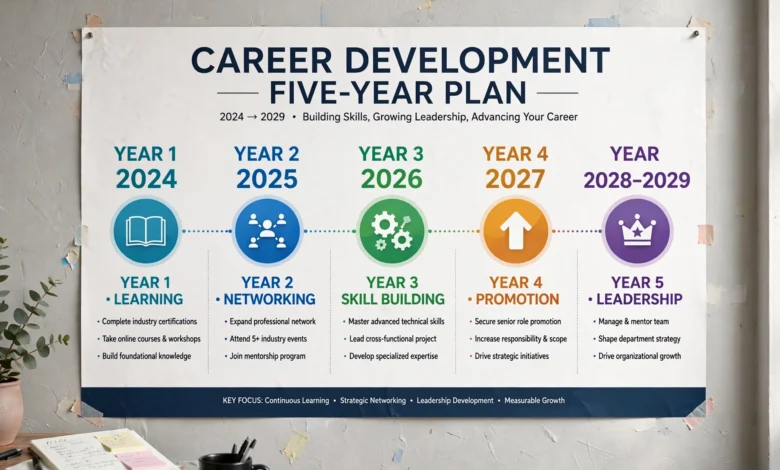
Say your five-year goal is to become a creative director. Your yearly milestones might look like:
- Year 1: Take on a project lead role, start building a portfolio of larger campaigns
- Year 2: Manage a small team on a project basis, get feedback on leadership style
- Year 3: Move into a formal senior or lead role, begin mentoring junior staff
- Year 4: Take ownership of a full department’s creative output for at least one client or product line
- Year 5: Step into or apply for creative director roles, either internally or externally
Each milestone should follow the basic logic of a SMART goal: specific, measurable, achievable, relevant, and time-bound. Vague milestones like “get better at leadership” are hard to track. “Lead a cross-functional project with at least three team members by Q3” is something you can actually check off.
This is also where a five-year plan starts to feel less overwhelming. Instead of staring at a five-year gap, you’re only ever looking at the next 12 months.
Step 4: Identify the Skills, Credentials, and Experience You’ll Need
Now look at the gap between your current skill set and what your Year 5 destination actually requires. This step takes some research, not guesswork.
A few ways to figure out what’s actually needed:
- Read job postings for the role or outcome you’re aiming for, even if you’re not applying yet. Look for skills and qualifications that show up repeatedly.
- Talk to people already there. Ask what actually got them to that position, not just what their job description says.
- Look at internal promotion patterns if you’re staying within your current company. What did the last three people promoted to that level have in common?
- Check for formal credentials that matter in your field, whether that’s a certification, an advanced degree, or a specific technical skill.
Once you know the gaps, pick one or two skills to focus on at a time rather than trying to fix everything at once. Trying to learn five new competencies simultaneously usually means making real progress on none of them. According to Indeed’s career development guidance, breaking a long-term plan into smaller, sequential steps is what makes it achievable rather than just aspirational.
Step 5: Build Networking and Visibility Into the Plan
Skills alone don’t move a career plan forward. People need to know you have them. This step gets left out of a lot of career plans, but it’s often the difference between a plan that stalls and one that actually produces results.
A few low-effort habits that compound over time:
- Send one message a week to someone doing the kind of work you want to be doing in five years, and ask a specific, thoughtful question.
- Share what you’re working on and learning, whether that’s internally at your company or publicly through writing or speaking.
- Volunteer for visible projects, not just important ones. Being seen doing good work matters almost as much as doing it.
- Keep a running list of people who could vouch for you when a promotion, referral, or introduction comes up.
None of this needs to feel like networking in the transactional sense. It’s really just staying connected to your field and making sure your growth is visible to the people who can open doors for you.
Step 6: Write It Down and Pick a Format That Works for You
A career plan that lives only in your head isn’t a plan, it’s a daydream. Writing it down forces clarity and gives you something to actually revisit.
There’s no single right format. Some people prefer:
- A simple document with sections for each year
- A spreadsheet tracking goals, skills needed, and deadlines
- A slide deck they update quarterly
- A journal where they write freeform reflections alongside concrete goals
What matters more than the format is that it includes four things for each stage of your plan:
- The specific goal for that year
- The skills or experience required to hit it
- The resources or support you’ll need (a course, a mentor, a budget)
- A realistic deadline
Keep it somewhere you’ll actually look at again. A plan buried in a folder you never open does nothing.
Step 7: Review, Revise, and Stay Flexible
This is the step that separates a five-year career plan that actually works from one that quietly falls apart around month four. Life changes. Companies restructure. Interests shift. A plan that can’t bend will eventually break.
Set a rhythm for checking in on your plan:
- Monthly: A quick check on whether you’re taking any action toward your current year’s milestones.
- Quarterly: A more honest look at whether the milestone is still realistic, and whether anything needs adjusting.
- Annually: A full review of the whole plan. Is the five-year destination still the right one? Have your priorities changed? Do the yearly milestones need to shift?
If something isn’t working, change it. The point of the plan is to serve you, not the other way around. Treating it as a fixed contract you can never renegotiate is exactly what causes people to abandon career planning altogether after the first setback.
Common Mistakes That Sink a Five-Year Career Plan
A few patterns show up again and again in plans that don’t stick:
- Being too vague. “Advance my career” isn’t a goal you can act on or measure.
- Being too rigid. Locking onto one exact job title and refusing to adjust when circumstances change.
- Skipping the audit step. Setting goals without an honest look at your starting point leads to plans that don’t fit your actual strengths.
- Ignoring visibility. Doing great work quietly rarely gets you promoted on its own.
- Never revisiting the plan. A document written once and never opened again isn’t a living plan, it’s a time capsule.
- Trying to fix everything at once. Spreading your focus across too many skills or goals at the same time usually means slower progress on all of them.
Avoiding these is often more important than getting every detail of the plan perfect on the first try.
A Simple Five-Year Career Plan Example
To make this concrete, here’s a stripped-down example for someone currently working as a marketing coordinator who wants to become a marketing director in five years:
- Current role: Marketing coordinator, two years of experience
- Five-year goal: Marketing director overseeing a team of six or more
- Year 1: Take ownership of one full campaign end to end, request feedback from manager quarterly
- Year 2: Move into a marketing manager role, begin managing one direct report
- Year 3: Expand team to three people, complete a leadership training program
- Year 4: Own budget planning for the department, build relationships with senior leadership
- Year 5: Apply for or step into a director-level role, either internally or at a new company
This structure works for almost any field. Swap the titles and skills, and the same yearly logic applies whether the goal is a technical leadership role, a career switch into a new industry, or building a business on the side.
Conclusion
A five-year career plan works when it’s specific enough to act on but flexible enough to survive the unpredictability of real life. Start with an honest audit of where you stand, define a destination built around a theme rather than a single fixed title, break that destination into yearly milestones, and identify the skills and relationships you’ll need along the way.
Write the plan down, revisit it regularly, and be willing to adjust it as your circumstances and interests change. Do that consistently, and a five-year career plan stops being an abstract exercise and becomes the thing that actually gets you where you want to go.